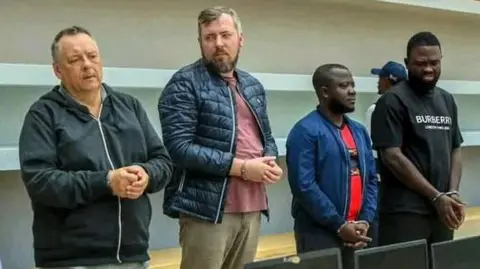
Two Russians are due to go on trial in Angola accused of stirring up anti-government protests, conducting a campaign of disinformation, and attempting to interfere in next year's presidential election.
Arrested last August, political consultant Igor Ratchin and translator Lev Lakshtanov are facing 11 charges, including terrorism, espionage, and influence peddling.
The BBC has obtained a copy of the indictment that includes charges relating to an alleged operation aimed at changing the political course of Angola.
The Russians' lawyers challenge the indictment on the grounds that it lacks 'concrete and objective facts'.
According to the prosecution, the Russians acted on behalf of Africa Politology, a shadowy network of operatives and intelligence officers in Africa that emerged from the now-defunct Wagner Group, whose founder Yevgeny Prigozhin died in 2023 in a plane crash.
Political operatives linked to Wagner have been active across Africa for more than a decade, particularly in the Central African Republic, Mali, and Madagascar.
The Russians' defence team insists they are not connected to Africa Politology or the Wagner Group, asserting they were merely cooperating to establish a cultural 'Russian House' in Luanda.
Angola's strategic resources, particularly oil and diamonds, have kept it on Russia's radar, despite its gradual shift away from Moscow's influence since the Cold War.
The defense team also argues the accusations against Ratchin and Lakshtanov are politically motivated, amid a backdrop where Angola's President João Lourenço has pivoted towards Western alliances.
Charges stem from events following a series of violent protests in July 2025, illustrating the nexus between economic hardship and political action in the country. Angolan authorities have framed the defendants as orchestrators of those protests, although many contest this narrative, suggesting the demonstrations stemmed from genuine public discontent.
'People were protesting because of their living conditions, not because someone from another country told them to,' says Sheila Nhancale, an Angola researcher at Human Rights Watch.
With the upcoming trial, questions linger about the extent of foreign influence and the implications for Angola's domestic politics and international relations.