In brief
Vladimir Putin's recent visit to Beijing showcased deep symbolic ties with Chinese President Xi Jinping—marked by ceremonial greetings, nostalgic musical tributes, and repeated references to 'strategic partnership.' Yet behind the rhetoric of 'mutual respect,' Beijing's refusal to finalize the Power of Siberia 2 pipeline deal reveals fundamental geopolitical realities: Russia seeks to offset European market losses through Chinese gas exports, while China prioritizes energy diversification and avoids over-reliance on Russian fossil fuels. The Kremlin's acknowledgment that 'the positions of Russia and China are not identical' highlights how even close allies operate from divergent strategic interests. Meanwhile, Putin's recent dismissal of the illusory 'spirit of Anchorage'—a former Trump-Putin diplomatic buzzword—signals Russia's pragmatic shift toward Beijing as a more reliable geopolitical ally, but one that still navigates mutual commercial caution.
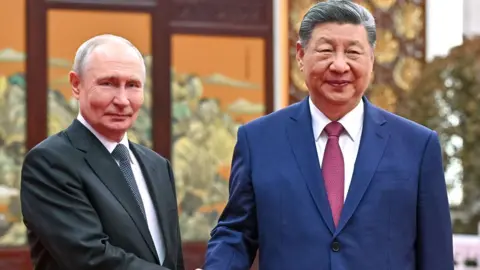
The red carpet at Beijing's Great Hall of the People was adorned with Russian flags, yet the atmosphere felt strangely familiar—almost like Moscow. As Vladimir Putin and Xi Jinping exchanged handshakes, a Chinese military band played the hauntingly romantic 'Moscow Nights,' its lyrics echoing 'If only you knew how these Moscow Nights are dear to me.' Putin’s greeting—'My dear friend'—matched Xi’s reply: 'My old friend.' Their camaraderie was undeniable, reflecting a partnership nurtured over 40 meetings, public pledges of 'strategic cooperation,' and joint criticisms of US nuclear policies. The Russian government newspaper even ran side-by-side photos of Trump's solitary departure from China earlier that week, contrasting it with Putin and Xi's solidarity.But this wasn't the realm of love songs or bromance—it was geopolitics in action. Russia's hopes for the Power of Siberia 2 pipeline—a lifeline to replace lost European gas markets—remained unfulfilled. Despite last year's memorandum of understanding, Beijing avoided finalizing terms, citing pricing concerns and a strategic pivot toward energy diversification. 'The positions of Russia and China are not identical,' acknowledged the Kremlin’s official paper, the same publication that had trumpeted their alliance. Russian officials were disappointed but unsurprised, recognizing that 'with two countries of this size, both with a great-power psyche, it couldn’t be any other way.'This pragmatism contrasts sharply with Russia's brief flirtation with the 'spirit of Anchorage'—a term used after Putin-Trump's 2023 Alaska summit to suggest progress on Ukraine peace talks. But as the war in Ukraine persisted, that optimism evaporated. When asked about the Anchorage connection during Beijing talks, Putin’s aide Yuri Ushakov simply stated: 'The spirit of Beijing exists. But the spirit of Anchorage? I never used that phrase.' While Moscow celebrates its warming ties with Beijing, the reality remains clear: friendship is strategic, not sentimental—especially when energy deals are at stake.}