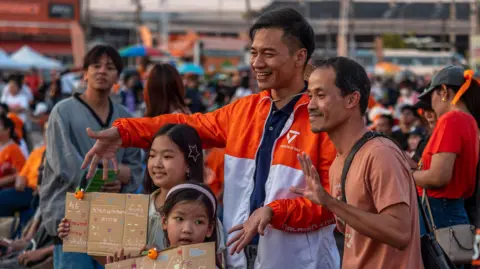
Suttasitt Macky Pottasak is a typical candidate of Thailand's People's Party: young, idealistic and hardworking.
He gave up a career in TV drama production in Bangkok to run in the last election, winning a rural seat near his home city of Nakhon Ratchasima from an old, established political family. He has adopted the hat and flag of Luffy, the main character in the Japanese anime series One Piece, which has featured in recent youth protests in Asia. He makes light-hearted videos about his party's policies every day, which are getting millions of views on social media.
Politics is something past generations made boring. I want to make it fun, he says. That's why I brought in Luffy and my video mini-series. We don't have money to buy votes. We are just ordinary citizens, but with a strong determination to solve the long-standing problems. I think the villagers can see that.
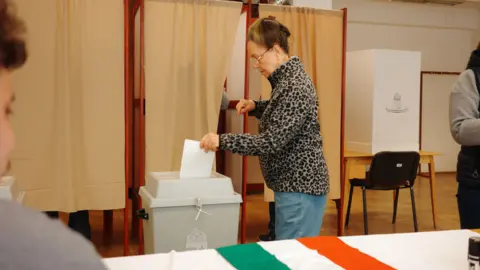
Opinion polls suggest that much of the Thai public agrees with the People's Party. They are polling consistently ahead of their rivals as the election on Sunday draws near.
But in Thailand, winning an election is never enough.
The last one, less than three years ago, produced a surprise win for the progressive Move Forward party, which had campaigned on promises of root-and-branch political and economic reforms. These included making Thailand's powerful military, and its largest businesses, more accountable, and reducing the heavy punishments under the notorious lese majeste law.
But powerful conservative forces, in particular the unelected senate and the constitutional court, blocked Move Forward from forming a government, dissolved the party and banned its leaders from politics. The court ruled that its proposals for the lese majeste law amounted to an attempt to overthrow the entire political system.
Now, after three tumultuous years of short-lived coalition administrations, the sacking of two prime ministers by the constitutional court and a border war with Cambodia, the reformists are making another bid for power, this time under a new name, the People's Party.
Their youthful energy and idealism still draw large and excited crowds. At a rally in Nakhon Ratchasima, the new party leader, Natthaphong Ruengpanyawut, a 38-year-old former software engineer, was mobbed like a rock star, people queueing for selfies with him and wrapping him in garlands of flowers.
Macky and two assistants tour his constituency on e-scooters, passing irrigation canals, rice fields and the simple wooden houses characteristic of north-eastern Thai villages, listening to the concerns of the residents. They tell a story of a society under acute economic stress, where the old engines of growth have stopped working.
The village head La-or Kohsantea says there are few decent jobs in the area, so young people have to leave to find work. No-one has helped us with the problem of poverty, she says. Thailand has one of the highest levels of household debt in Asia. GDP is growing at less than 2% a year, far lower than neighbouring countries.
Kritsana Lohsantea, 28, is asking Macky to help him get a modest social security payment when the electronics factory he works at closes down later this year.
Like many young Thais in rural areas, he left school at 15 with few qualifications, but the low-skilled manufacturing jobs that helped Thailand grow rapidly 30 or 40 years ago are now moving to lower-cost locations like Vietnam.
Macky has also noticed how many elderly people there are in the area. Thailand's population has been falling for five years. Last year the number of births fell 10%, the highest rate in the world.
With so many young people leaving the village, Macky is proposing local training and a better online system for organizing caregivers, to look after house-bound old people who no longer have family members living with them.
The People's Party stands out for its ambition to transform Thailand.
It has prioritized amending the constitution, which was drafted under military rule and gives a lot of power to unelected agencies like the constitutional court to constrain elected governments. The party wants to streamline the country's extensive bureaucracy, modernize its education system, and curb the power of the military and the biggest businesses. It also supports amending the military-drafted constitution, a question that will be put in a referendum at the same time as the election.
Yet, everyone in Thailand expects some kind of move to block the People's Party once again. A case has been filed against 44 of its leading figures - including 15 of their parliamentary candidates - with the National Anti-Corruption Commission, over their personal endorsement of the lese majeste proposals.
That could be used to bar them all from politics. Two of their candidates are also facing jail time under that law.
They are afraid of us, Thanathorn told the BBC, as he prepared to join a People's Party campaign bus. They are afraid of change. They want tomorrow to be just like yesterday. They think dissolving our parties, banning our leaders from politics, would make us smaller. In fact, we are getting bigger.
Even if his party is allowed to join a government, the constraints on what they can do in office remain in place. That is why they have made reforming the constitution such a high priority, to dilute or end the extraordinary powers that deeply conservative institutions like the constitutional court have to unseat elected governments.
If Thailand was a functional democracy, none of this would have happened, says Siripan Nogsuan Sawasdee, a political scientist from Chulalongkorn University. We have regular elections, sometimes punctuated by military coups. But elections only determine the representatives in the lower house of parliament. They do not determine who governs. That is determined by elite networks and unelected institutions which have played a veto role against the will of the voters.