In brief
President Trump has signed an executive order that prohibits states from enforcing their own AI regulations, aiming for a clear national framework. While technology companies applaud the decision for promoting uniformity, state leaders, particularly in California, criticize it as an overreach that undermines local protections. The order is seen as a pivotal development in the race for AI dominance against global competitors like China.
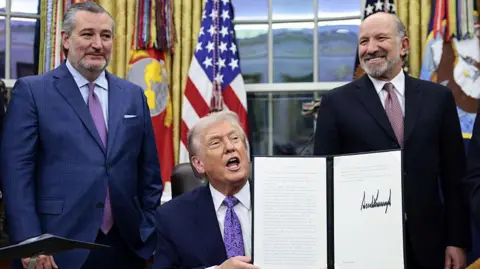
US President Donald Trump has signed an executive order aimed at blocking states from enforcing their own artificial intelligence (AI) regulations.
We want to have one central source of approval, Trump told reporters in the Oval Office on Thursday.
The order aims to empower the Trump administration to navigate and reject the most onerous state rules, as mentioned by White House AI adviser David Sacks, who clarified that the federal government would still support AI regulations focused on children's safety.
This decision is seen as a victory for technology giants who have been advocating for nationwide AI legislation, suggesting it could significantly influence America's ambition to lead in the rapidly evolving tech landscape.
AI company executives argue that state-level regulations might impede innovation and slow the United States’ advance against rivals like China, which are heavily investing in such technologies.
However, the executive order has prompted backlash. The state of California, home to many leading tech firms, already has its own AI regulations in place. California Governor Gavin Newsom sharply criticized Trump’s action, accusing him of corruption and asserting that it compromises state laws meant to safeguard Americans from unregulated AI technologies.
Earlier this year, Newsom enacted legislation requiring major AI developers to outline strategies to mitigate risks associated with their products. Other states, including Colorado and New York, have also passed laws regulating AI development.
Newsom emphasized that California's law serves as a model for national legislation. Critics of Trump's order argue that these state laws are crucial in the absence of robust federal measures to ensure safety and transparency in AI innovations.
Julie Scelfo from the advocacy group Mothers Against Media Addiction stated that eliminating a state’s ability to enforce its own AI safeguards undermines fundamental rights to protect residents.
However, some legal experts warn that a hodgepodge of state regulations could hinder the American AI industry. Michael Goodyear, an associate professor at New York Law School, pointed out that a uniform federal law could be more beneficial than conflicting state policies but cautioned that this depends on the effectiveness of any new federal legislation.
The tech lobby group NetChoice welcomed the executive order, expressing eagerness to collaborate with the White House and Congress to establish national standards and guidelines for innovation.