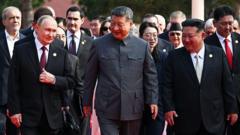
As they strolled through Tiananmen Square in Beijing last September, Chinese President Xi Jinping and Russian President Vladimir Putin appeared to muse over the possibility that organ transplants could dramatically extend human life.
Human organs can be continuously transplanted. The longer you live, the younger you become, and even achieve immortality, Putin's interpreter was heard saying.
Some predict that in this century, humans may live up to 150 years old, Xi's interpreter was heard responding.
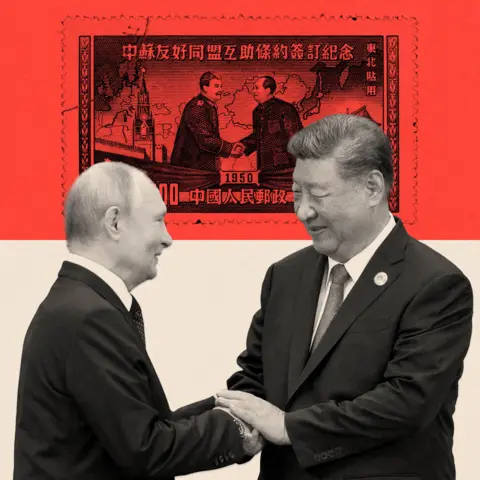
It was a fitting conversation for two strongmen, who have described each other as best friends, and who, after a combined 39 years in power, show no signs of stepping down. This was a rare insight into what is quite a misunderstood partnership. This scrap of unscripted conversation is one of the few glimpses into a highly secretive relationship.
Putin will be returning to Beijing this week, coinciding with the 25th anniversary of the Treaty of Good-Neighbourliness and Friendly Cooperation between Russia and China.
Years of western sanctions have gradually pushed Moscow deeper into trade engagement with Beijing, where China now plays a crucial role in providing essential technology and expertise to Russia. As the relationship deepens, so does the economic reliance of Russia on China.
There exists a significant power asymmetry; China is Russia's largest trading partner, while Russia represents a mere 4% of China’s international trade. The need for China has grown particularly acute since the conflict in Ukraine, with reports indicating that over 90% of Russia's remotely sanctioned technology is being sourced from China.
Despite these dynamics favoring China, there is an understanding that Russia wishes to maintain its sovereignty and avoid being perceived as a vassal state. Comments from Russian officials indicate a desire for an equal footing in negotiations, revealing underlying tensions in how the relationship can evolve.
Moreover, the human dimension of the Russia-China relationship is evident, with leaders promoting a seamless bond between their governments, even if popular sentiment among citizens may not reflect this camaraderie. For instance, Chinese preferences for studying abroad or investing tend to favor Western countries over Russia.
Nonetheless, the interconnectedness between these two nations has grown stronger, driven largely by geopolitical shifts, economic needs, and mutual interests against the backdrop of a changing global landscape.
As both nations navigate their strategic partnership, the resilience of their relationship appears fortified by a shared understanding of reliance, challenges, and broader regional dynamics, ensuring that it remains a significant element of global geopolitics.