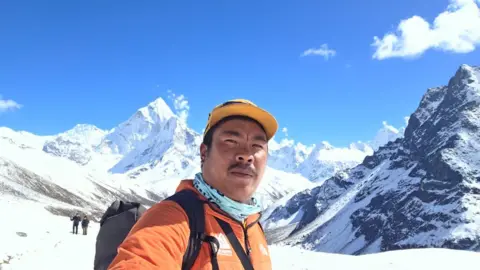
An early flood warning system designed to save the lives of thousands of people in the Everest region may no longer be working, Nepalese officials have admitted to the BBC, after it was allowed to fall into a state of disrepair. The disclosure came after villagers in the local Sherpa communities told the BBC no inspection of the UN-supported project had been carried out for many years after the dangerous Imja glacial lake was last drained in 2016. Since then, no maintenance has been undertaken, which means siren towers have been left to rust, while some have even had their batteries stolen, according to locals.
On top of this, the satellite data reception transmitting the lake's water level - which can then be used to send out mobile phone alerts to locals - has been unreliable, officials at Nepal's department of hydrology and meteorology (DHM) told the BBC. The Imja lake, which sits at a little over 5,000m (16,400ft) above sea level, has not burst since it was drained a decade ago - at which point, it was almost 150m deep in places.
Back then, the depth of the lake was reduced by about 3.5m as part of a $3.5m risk reduction project, which included the early warning system. But scientists warn global warming-induced fast melting glaciers are causing many Himalayan glacial lakes to expand dangerously - meaning they can then burst out and sweep away downstream settlements, trekking routes and bridges.
In the Everest region alone, there have been at least five floods from glacial lakes in the last five decades, leaving those living in Imja lake's path fearing for the future. Village leaders have expressed serious concerns over the unmaintained warning system. 'Going by the state of the siren towers, we don't expect to get any flood warning from them even when Imja lake bursts out,' said Ang Nuru Sherpa, chairman of the Chaurikharka buffer zone area adjoining the Sagarmatha national park in the Everest region.
Despite these challenges and the pressing need for repairs, a lack of government budget has inhibited maintenance efforts. 'We cannot say for sure if the early warning sirens work or they don't,' said Niraj Pradhananga, a senior meteorologist in the DHM.
Meanwhile, local communities continue to press for action, as they grapple with the imminent risk of flood disasters while officials acknowledge the urgency but struggle with resource allocation. With the onset of every tourist season, the urgency for a functional warning system intensifies, highlighting the precarious situation that the vulnerable populations face in the shadows of the mighty Himalayas.
On top of this, the satellite data reception transmitting the lake's water level - which can then be used to send out mobile phone alerts to locals - has been unreliable, officials at Nepal's department of hydrology and meteorology (DHM) told the BBC. The Imja lake, which sits at a little over 5,000m (16,400ft) above sea level, has not burst since it was drained a decade ago - at which point, it was almost 150m deep in places.
Back then, the depth of the lake was reduced by about 3.5m as part of a $3.5m risk reduction project, which included the early warning system. But scientists warn global warming-induced fast melting glaciers are causing many Himalayan glacial lakes to expand dangerously - meaning they can then burst out and sweep away downstream settlements, trekking routes and bridges.
In the Everest region alone, there have been at least five floods from glacial lakes in the last five decades, leaving those living in Imja lake's path fearing for the future. Village leaders have expressed serious concerns over the unmaintained warning system. 'Going by the state of the siren towers, we don't expect to get any flood warning from them even when Imja lake bursts out,' said Ang Nuru Sherpa, chairman of the Chaurikharka buffer zone area adjoining the Sagarmatha national park in the Everest region.
Despite these challenges and the pressing need for repairs, a lack of government budget has inhibited maintenance efforts. 'We cannot say for sure if the early warning sirens work or they don't,' said Niraj Pradhananga, a senior meteorologist in the DHM.
Meanwhile, local communities continue to press for action, as they grapple with the imminent risk of flood disasters while officials acknowledge the urgency but struggle with resource allocation. With the onset of every tourist season, the urgency for a functional warning system intensifies, highlighting the precarious situation that the vulnerable populations face in the shadows of the mighty Himalayas.