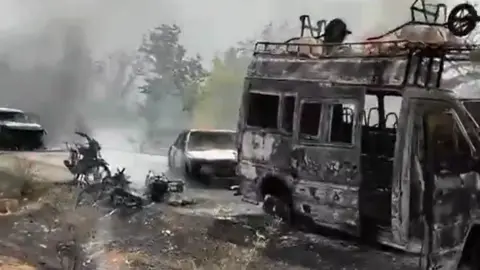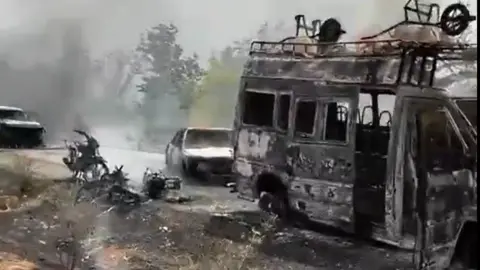
In a move intensifying Mali's humanitarian crisis, jihadist militants torched dozens of vehicles—including fuel tankers, minibuses, and trucks—near Bamako on Tuesday, escalating a blockade that threatens to cripple the economy before Eid al-Adha. The BBC has verified footage showing charred remains on a major road approximately 45 kilometers west of the capital, where militants reportedly forced drivers to evacuate before setting the vehicles alight. No casualties were reported, but the attack marks a dangerous escalation following last month's coordinated assault by ethnic Tuareg separatists and JNIM that killed Defense Minister Sadio Camara in a suicide truck bombing.
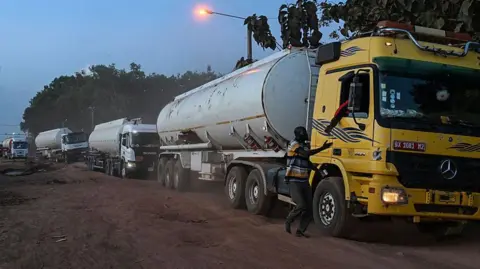
The blockade, first imposed by the al-Qaeda-affiliated JNIM in 2025, aims to starve Mali's economy and weaken junta leader Gen. Assimi Goïta's government. BBC Verify authenticated the recent attack by cross-referencing video evidence with satellite imagery and confirming the heat signature using NASA's Firms platform. Since last year, JNIM has systematically burned over 100 fuel trucks on key highways, kidnapping drivers to disrupt supply routes to Bamako. Despite military escorts, the blockade has caused catastrophic shortages, with prices for a kilo of potatoes soaring from 350 to 500 CFA francs ($0.62 to $0.90) and meat becoming nearly unaffordable.
The crisis has severely impacted traditional Eid preparations. Shepherds report livestock seizures by militants, forcing many families to forgo the ritual slaughter of animals—a cornerstone of Eid al-Adha. 'Lots of people are blocked on the road. People are afraid because they [Islamists] take the animals,' said one sheep vendor. Residents like Moussa, a Bamako resident, now avoid travel altogether: 'Travelling would put your life at risk, as well as that of your family. I've decided to stay and celebrate in Bamako.'
The junta, which took power in 2020 after promising to restore security, has struggled to contain the insurgency despite Russian paramilitary forces like Africa Corp—evolved from Wagner Group—providing aerial escorts for convoys. While the Kremlin pledges continued support against 'extremism and terrorism,' the junta faces mounting domestic discontent. In January, Gen. Goïta appointed Brig. Gen. Famouké Camara to lead a special operation against the blockade, but attacks continue unabated. With Eid approaching, the blockade risks deepening economic despair and social unrest across Mali's Muslim-majority population, who historically gather in streets to celebrate with animal sacrifices—a tradition now severely disrupted.
Analysts warn the junta's reliance on Russian mercenaries may undermine its legitimacy as the militant offensive spreads. Meanwhile, the global community watches as Mali's security vacuum fuels regional instability, with the economic stranglehold on Bamako revealing the junta's fragile hold on power amid the festivity of Eid.}
The blockade, first imposed by the al-Qaeda-affiliated JNIM in 2025, aims to starve Mali's economy and weaken junta leader Gen. Assimi Goïta's government. BBC Verify authenticated the recent attack by cross-referencing video evidence with satellite imagery and confirming the heat signature using NASA's Firms platform. Since last year, JNIM has systematically burned over 100 fuel trucks on key highways, kidnapping drivers to disrupt supply routes to Bamako. Despite military escorts, the blockade has caused catastrophic shortages, with prices for a kilo of potatoes soaring from 350 to 500 CFA francs ($0.62 to $0.90) and meat becoming nearly unaffordable.
The crisis has severely impacted traditional Eid preparations. Shepherds report livestock seizures by militants, forcing many families to forgo the ritual slaughter of animals—a cornerstone of Eid al-Adha. 'Lots of people are blocked on the road. People are afraid because they [Islamists] take the animals,' said one sheep vendor. Residents like Moussa, a Bamako resident, now avoid travel altogether: 'Travelling would put your life at risk, as well as that of your family. I've decided to stay and celebrate in Bamako.'
The junta, which took power in 2020 after promising to restore security, has struggled to contain the insurgency despite Russian paramilitary forces like Africa Corp—evolved from Wagner Group—providing aerial escorts for convoys. While the Kremlin pledges continued support against 'extremism and terrorism,' the junta faces mounting domestic discontent. In January, Gen. Goïta appointed Brig. Gen. Famouké Camara to lead a special operation against the blockade, but attacks continue unabated. With Eid approaching, the blockade risks deepening economic despair and social unrest across Mali's Muslim-majority population, who historically gather in streets to celebrate with animal sacrifices—a tradition now severely disrupted.
Analysts warn the junta's reliance on Russian mercenaries may undermine its legitimacy as the militant offensive spreads. Meanwhile, the global community watches as Mali's security vacuum fuels regional instability, with the economic stranglehold on Bamako revealing the junta's fragile hold on power amid the festivity of Eid.}