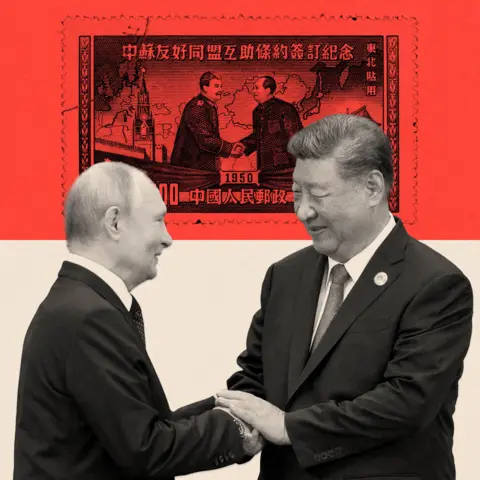
As they strolled through Tiananmen Square in Beijing last September, Chinese President Xi Jinping and Russian President Vladimir Putin appeared to muse over the possibility that organ transplants could dramatically extend human life.
Human organs can be continuously transplanted. The longer you live, the younger you become, and even achieve immortality, Putin's interpreter was heard saying.
Some predict that in this century, humans may live up to 150 years old, Xi's interpreter was heard responding. This candid moment was not just a whimsical conversation; it encapsulated the nuanced dynamics of the long-standing partnership between the two leaders.
The upcoming return of Putin to Beijing coincides with the 25th anniversary of the Treaty of Good-Neighbourliness and Friendly Cooperation between the two nations. Such anniversaries often spark reflections on the substance of their relationship.
While Western narratives may label their alliance as an 'axis of authoritarianism', the reality seems more complex. Their relationship is indeed asymmetric; Russia finds itself economically reliant on China, as it positions itself as Beijing's significant partner in various sectors, particularly in energy and military technology.
Despite these dependencies, both countries exhibit caution. Chinese experts suggest that while Beijing is keen on maintaining ties, it is equally prudent in understanding the sensitive dynamics of this relationship, ensuring not to provoke Russian pride.
The economic partnership remains robust: Russia continues to supply energy resources vital to China's growing industrial economy. Reports indicate that a major gas pipeline deal is on the horizon, which would strengthen China's energy security amid global unrest.
However, this partnership is not without its tensions. Moscow remains aware of the dangers inherent in becoming too subordinate to China’s interests. Leaders from both nations have articulated a vision of mutual respect, suggesting that neither intends to dominate the other.
As they navigate around areas of divergence, both countries foster their relationship based on shared political interests, including their mutual opposition to Western dominance. Nevertheless, the fluctuating geopolitics of their engagement with other nations, especially concerning Taiwan, illustrate not only their cooperation but their individual strategies in securing national goals.
Ultimately, the Sino-Russian partnership appears to endure due to a combination of pragmatic necessity and cultural exchanges at various societal levels. Increased travel and economic cooperation, in light of Western sanctions, could signal deeper ties emerging between the two countries, albeit with all the challenges associated with power asymmetries.
In essence, while the relationship displays significant imbalances, both sides recognize its crucial importance—indicating that, for now, their alliance is likely to endure.