Three Russian submarines conducted a covert operation over cables and pipelines in waters north of the UK, Defence Secretary John Healey said.
A British warship and aircraft were deployed to deter the malign activity by Moscow and there was no evidence of any damage to UK infrastructure in the Atlantic, he added.
Addressing Russian President Vladimir Putin directly, Healey said: We see you. We see your activity over our cables and our pipelines, and you should know that any attempt to damage them will not be tolerated and will have serious consequences.
The Russian embassy in London has denied Healey's claims, according to Moscow's state news agency Tass.
The UK is dependent on its undersea cables and pipelines for its data and energy.
There are around 60 undersea cables which come ashore at several points along the UK coastline, particularly around East Anglia and South West England.
More than 90% of the UK's day-to-day internet traffic travels via these undersea cables.
Healey told a Downing Street press conference on Thursday that Russia had sent an Akula class submarine as a diversionary tactic while two of its GUGI spy submarines carried out the surveillance of these cables.
Healey said the attack submarine soon left UK waters and went back to Russia after it was monitored, while the two GUGI vessels remained.
Tass reported that the embassy said Russia was not threatening underwater infrastructure, which is truly critical to the UK. We are not using aggressive rhetoric in this regard.
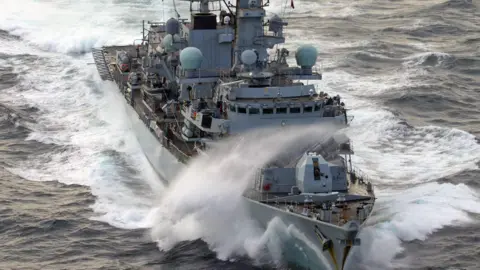
The Royal Navy deployed frigate HMS St Albans, fuel tanker RFA Tidespring and anti-submarine Merlin helicopters to track all three of the Russian submarines.
Other nations were involved in tracking the Russian activity - though Healey mentioned only Norway by name.
Our armed forces left [Russia] in no doubt that they were being monitored, that their movements were not covert, as President Putin planned, and that their attempted secret operation had been exposed, Healey said.
We watched them, we were able to track them, we dropped sonar buoys to demonstrate to them that we were monitoring every hour of their operation.
GUGI is not yet as familiar to most people as say, the KGB or FSB, but it poses a formidable and dangerous challenge to Western nations. The acronym stands for the Russian words for Main Directorate for Deep Sea Research (Glavnoye upravlenie glubokovodnikh issledovanii).
Its headquarters are in St.Petersburg on the Baltic Sea but it has an Arctic base from which it can deploy at Olenya Bay, up on the Kola Peninsula which is home to Russia's strategic nuclear submarine fleet.
This operation reflects a broader concern regarding hybrid warfare tactics employed by Russia.