Russia’s foreign ministry has publicly declared that it will launch a further “systematic” wave of attacks against the Ukrainian capital, Kyiv, after a massive strike night that left four civilians dead and 100 wounded. According to an official statement, the new assaults would target “decision‑making centres and command posts” and also focus on drone manufacturing facilities within the city.
In a separate communiqué, Moscow urged foreign nationals and diplomatic staff to leave Kyiv as soon as possible and warned residents to steer clear of administrative and military buildings. The call, viewed by many experts, is seen as a form of psychological pressure aimed at undermining the morale of civilians and international community presence.
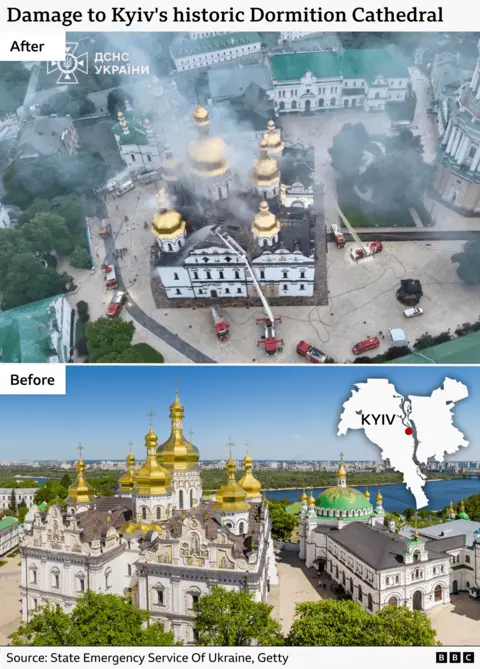
The large‑scale strike that just ended involved dozens of ballistic missiles, cruise missiles and hundreds of drones. In addition to destroying civilian infrastructure—such as the Chernobyl Museum and the National Art Museum—Russian forces also fired a hypersonic, nuclear‑capable Oreshnik missile near Bila Tserkva, 90 km south of Kyiv.
These actions come after Moscow’s claims that the attack was a retaliation for a Ukrainian drone assault on a Russian‑occupied town of Starobilsk, where a student dormitory fell victim to a strike that killed 21 people. Ukraine’s military has maintained that its units target only elite Russian drone factories and deliberately avoid civilian areas.
Despite four and a half years of war, Ukraine has strengthened its air‑defence network and now intercepts a large proportion of incoming drones and missiles. However, the sheer volume of Russian sorties often overwhelms country‑wide and foreign‑provided defences, though Ukraine still relies significantly on external weapons from the US and Israel.
The latest threat and the shutdown of foreign presence in the city add a new layer of tension to an already brutal conflict, with the international community closely monitoring both strategic escalations and humanitarian impacts on Kyiv’s residents.
In a separate communiqué, Moscow urged foreign nationals and diplomatic staff to leave Kyiv as soon as possible and warned residents to steer clear of administrative and military buildings. The call, viewed by many experts, is seen as a form of psychological pressure aimed at undermining the morale of civilians and international community presence.
The large‑scale strike that just ended involved dozens of ballistic missiles, cruise missiles and hundreds of drones. In addition to destroying civilian infrastructure—such as the Chernobyl Museum and the National Art Museum—Russian forces also fired a hypersonic, nuclear‑capable Oreshnik missile near Bila Tserkva, 90 km south of Kyiv.
These actions come after Moscow’s claims that the attack was a retaliation for a Ukrainian drone assault on a Russian‑occupied town of Starobilsk, where a student dormitory fell victim to a strike that killed 21 people. Ukraine’s military has maintained that its units target only elite Russian drone factories and deliberately avoid civilian areas.
Despite four and a half years of war, Ukraine has strengthened its air‑defence network and now intercepts a large proportion of incoming drones and missiles. However, the sheer volume of Russian sorties often overwhelms country‑wide and foreign‑provided defences, though Ukraine still relies significantly on external weapons from the US and Israel.
The latest threat and the shutdown of foreign presence in the city add a new layer of tension to an already brutal conflict, with the international community closely monitoring both strategic escalations and humanitarian impacts on Kyiv’s residents.