Of all the warnings in President Trump's arsenal, quitting the NATO military alliance is among those he's wielded the most.
Now he's doing it again.
Asked by Britain's Telegraph newspaper if he is reconsidering U.S. membership of NATO, he said: Oh yes… I would say [it's] beyond reconsideration – fuming again that his partners weren't joining America's military operations against Iran.
I just think it should be automatic, he emphasized in his remarks to the paper.
Trump's invective underscore again his misunderstanding of how this 32-member alliance works. NATO's Article 5 does commit it to collective defense: an attack against one member is deemed to be an attack against all. However, invoking this principle requires consensus, with the 1949 treaty referring mainly to crises in Europe and North America.
One ally after another has held back from joining a war they weren't consulted on, as they still don't understand its goals amid mixed messaging from the Trump administration.
Article 5 has only been triggered once, after the September 11th attacks on the U.S. in 2001.
Trump also referenced Ukraine in the Telegraph, asserting: We've been there automatically, including Ukraine. After Russia's audacious full-scale invasion of Ukraine in February 2022, then-U.S. President Joe Biden took a leading role in shaping responses from Western governments, believing Putin's actions threatened them all.
NATO as an alliance provided assistance but avoided the prospect of becoming directly involved in the conflict.
Trump, even before entering the White House in 2017, repeatedly dismissed NATO as a paper tiger, described it as obsolete, and claimed it was costing a fortune for the U.S.
This year, he mocked the alliance, stating Russia would have occupied all of Ukraine if the U.S. had not been NATO's enforcer.
Trump almost pulled out in early 2019, with former NATO Secretary General Jens Stoltenberg noting signs that Trump was preparing to act on that threat.
He acknowledged publicly that Trump pressured NATO allies to increase military spending significantly, partly in response to Trump's threats and Russia's growing menace.
The current crisis is likely to strengthen the resolve of European countries and Canada to bolster their own defenses. Nevertheless, the dominance of the U.S. military remains paramount, accounting for roughly 62% of NATO's total defense spending.
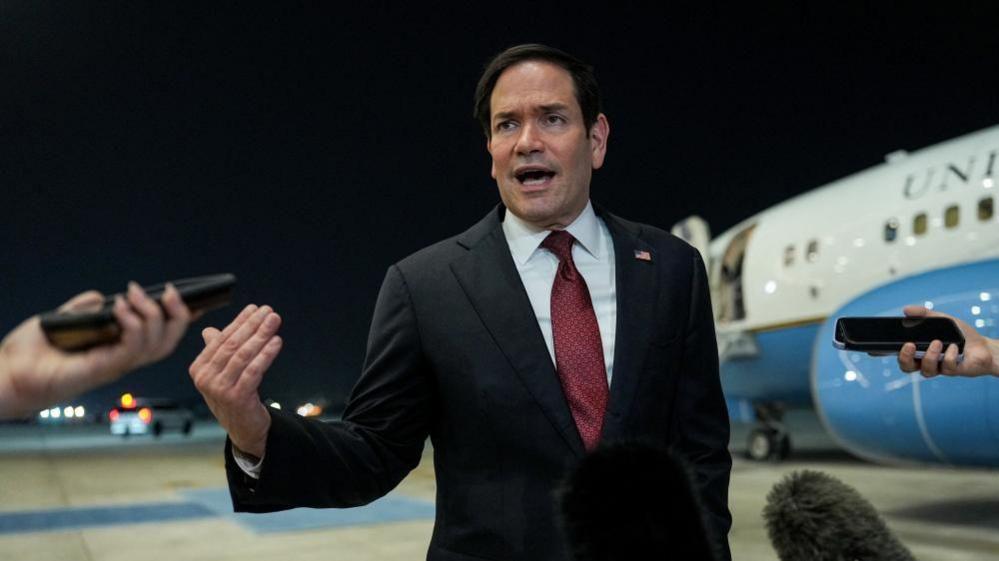
This week, Trump’s Secretary of State Marco Rubio suggested that post-conflict NATO relations would need reevaluation, claiming the NATO framework often feels like a one-way street favoring U.S. interests.
Given the U.S. Congress's recent vote prohibiting unilateral withdrawal from NATO, the future of the alliance seems inextricably linked to the willingness of the current administration to further its commitment. NATO leaders, particularly the current Secretary General Mark Rutte, will have to once again persuade Trump that remaining part of NATO serves both his interests and those of the United States as global threats persist.