When President Donald Trump deployed a wave of immigration officers across the Twin Cities, children in Columbia Heights were suddenly forced into lockdown. Outdoor classes became impossible, attendance collapsed, and the community’s parents stayed home with their kids while their children witnessed or heard about arrests, the detainment of informal teachers, and the shooting of a U.S. citizen by an ICE worker.
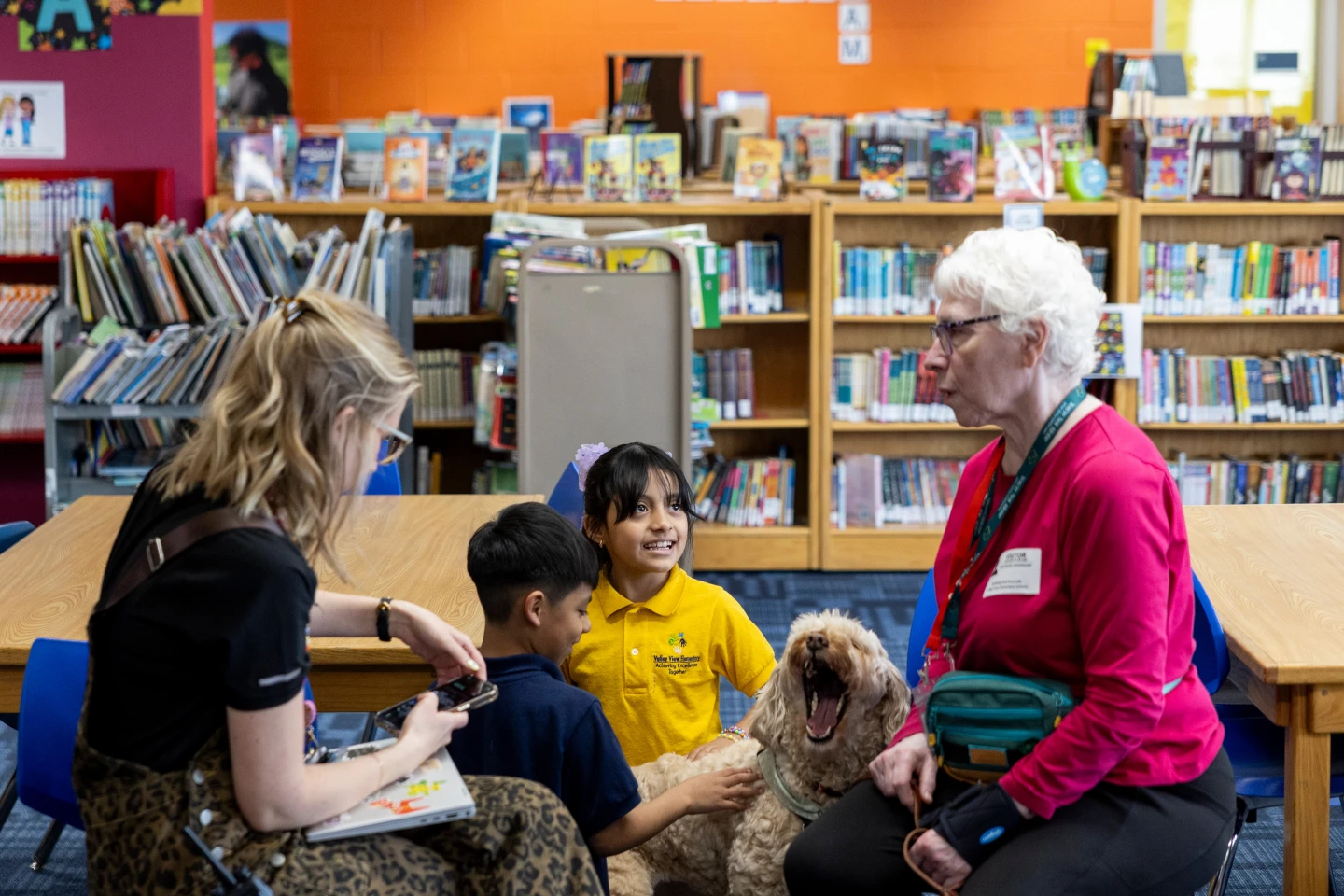
At Valley View Elementary, one of the schools hardest hit by the government’s crackdown, social worker Nicole Herje began a program to ease the trauma that many students were carrying. The program turned a quiet corner of the library into a safe space for the youngest children—a practice part of the school’s larger recovery plan as students returned to the classroom after months of virtual learning.
“The little girl approached Sage, the therapy dog. She touched the fluffy blond coat, and she said she liked it. In Ecuador I had a dog,” Herje recalled as she spoke to the group of kindergarteners.
So what’s a therapy dog doing two miles away from the stressful nights of hubcaps and helicopters? The answer lies in research that shows that prolonged exposure to high‑stress environments can reorganize brain structure in young children. Young kids on either side of the family chain—whether a mixed‑status family or one that was never touched by ICE—experience anxiety, loss of appetite, sleep disturbance, and overall exclusion from school life.
The program includes group therapy sessions led by Herje that incorporate Sage the goldendoodle as a “buddie.” Activities such as reading from *The Color Monster* or sharing happy and sad feelings help children articulate stressors. Herje asks, “When you’re happy, you laugh and jump and dance and play, and you want to share that feeling with everyone.” One girl answered: “When I want to go to school when I see my friends.” When asked what makes them sad, another spoke of her grandmother moving to Ecuador.
She also talks about the call of someone who lost a family member through deportation or was used as a hostage. In one case, a preschooler named Liam Conejo Ramos was detained by ICE after returning from school while he wore his ‘Spiderman backpack’ and a bright blue hat with bunny ears.
According to a report from the Brookings Institution, 4.6 million U.S.‑citizen children have a parent who is undocumented or has temporary legal status, and more than 200,000 have a parent who personally faced detention or deportation. These children exhibit chronic anticipatory anxiety that a loved one could be seized, leading to school absenteeism and emotional distress.
Little “Sage” only adds warmth and easy touch to the process, but the social worker’s testimony points toward a larger, more complex strategy: combining mental‑health, state‑wide policy reforms and community‑based involvement to help children recover.
In a community filled with fear, one application of therapy was stepped toward normal life: as many children reenter face‑to‑face schooling After a long virtual break, most of them stood together in the classroom. Herje watches with a soft smile as each child learns to unbind their fear—one smile at a time.
Valley View has identified several students who require extra help: two fifth‑graders and a second‑grader who had been detained at the Dilley Detention Center in Texas. Herje reports that each one had been stuck for weeks with inadequate food and no medical care.
The overarching link between simple acts such as having a therapy dog in a learning environment and how they help children unattended to their fears still opens the door for a widespread discussion on trauma‑enabled strategies for primary schools.
At Valley View Elementary, one of the schools hardest hit by the government’s crackdown, social worker Nicole Herje began a program to ease the trauma that many students were carrying. The program turned a quiet corner of the library into a safe space for the youngest children—a practice part of the school’s larger recovery plan as students returned to the classroom after months of virtual learning.
“The little girl approached Sage, the therapy dog. She touched the fluffy blond coat, and she said she liked it. In Ecuador I had a dog,” Herje recalled as she spoke to the group of kindergarteners.
So what’s a therapy dog doing two miles away from the stressful nights of hubcaps and helicopters? The answer lies in research that shows that prolonged exposure to high‑stress environments can reorganize brain structure in young children. Young kids on either side of the family chain—whether a mixed‑status family or one that was never touched by ICE—experience anxiety, loss of appetite, sleep disturbance, and overall exclusion from school life.
The program includes group therapy sessions led by Herje that incorporate Sage the goldendoodle as a “buddie.” Activities such as reading from *The Color Monster* or sharing happy and sad feelings help children articulate stressors. Herje asks, “When you’re happy, you laugh and jump and dance and play, and you want to share that feeling with everyone.” One girl answered: “When I want to go to school when I see my friends.” When asked what makes them sad, another spoke of her grandmother moving to Ecuador.
She also talks about the call of someone who lost a family member through deportation or was used as a hostage. In one case, a preschooler named Liam Conejo Ramos was detained by ICE after returning from school while he wore his ‘Spiderman backpack’ and a bright blue hat with bunny ears.
According to a report from the Brookings Institution, 4.6 million U.S.‑citizen children have a parent who is undocumented or has temporary legal status, and more than 200,000 have a parent who personally faced detention or deportation. These children exhibit chronic anticipatory anxiety that a loved one could be seized, leading to school absenteeism and emotional distress.
Little “Sage” only adds warmth and easy touch to the process, but the social worker’s testimony points toward a larger, more complex strategy: combining mental‑health, state‑wide policy reforms and community‑based involvement to help children recover.
In a community filled with fear, one application of therapy was stepped toward normal life: as many children reenter face‑to‑face schooling After a long virtual break, most of them stood together in the classroom. Herje watches with a soft smile as each child learns to unbind their fear—one smile at a time.
Valley View has identified several students who require extra help: two fifth‑graders and a second‑grader who had been detained at the Dilley Detention Center in Texas. Herje reports that each one had been stuck for weeks with inadequate food and no medical care.
The overarching link between simple acts such as having a therapy dog in a learning environment and how they help children unattended to their fears still opens the door for a widespread discussion on trauma‑enabled strategies for primary schools.