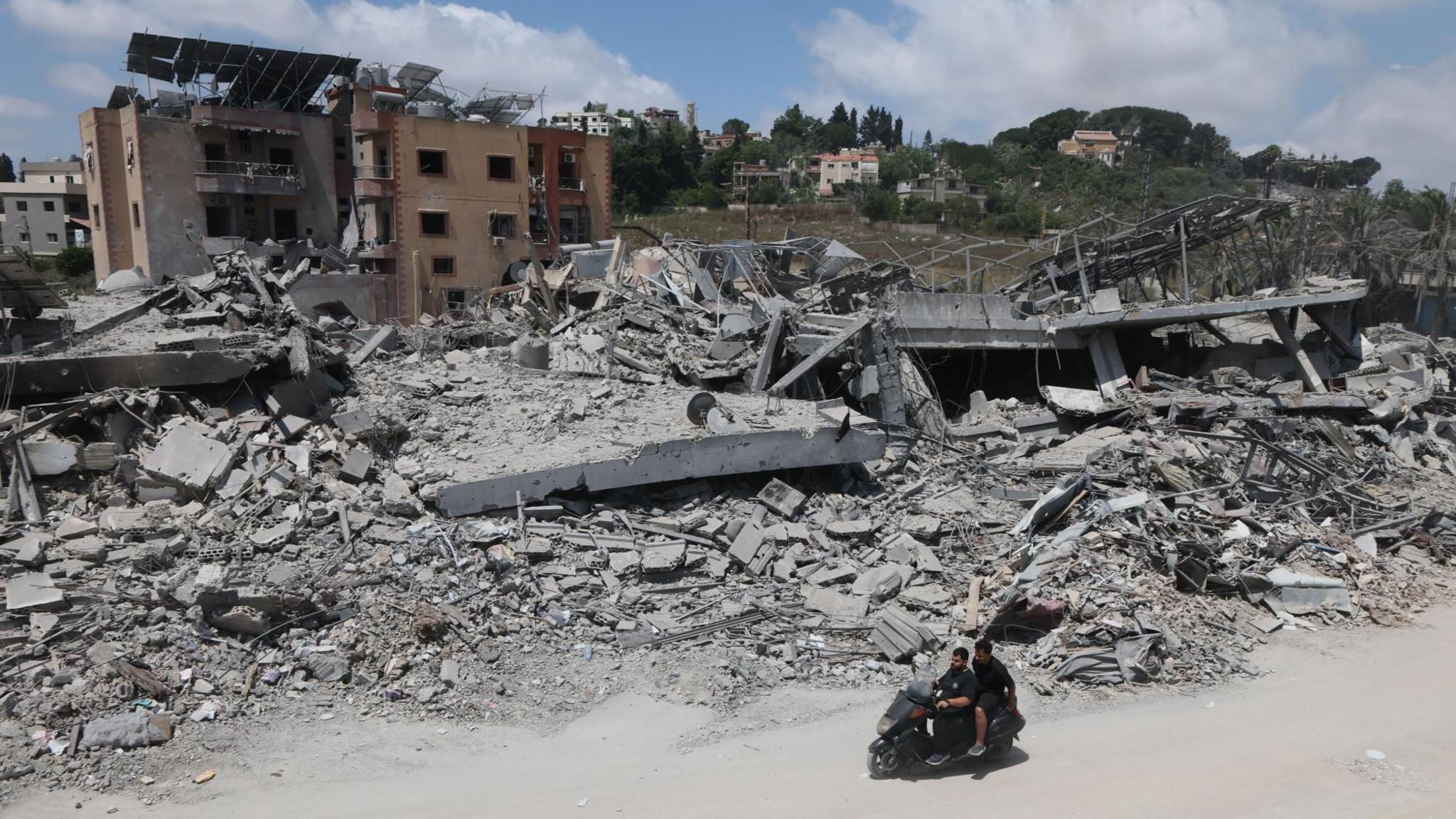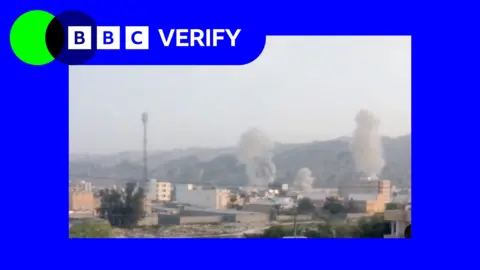
Multiple weapons experts have disputed a US claim that Iran may have been responsible for a deadly strike on the town of Lamerd on the first day of the war.
Six experts - who examined footage of the strike and all commented independently - contested the US suggestion that it was an Iranian missile, citing the missile's visual features, the way it exploded, its trajectory and the number of strikes in the area as the basis for their analysis.
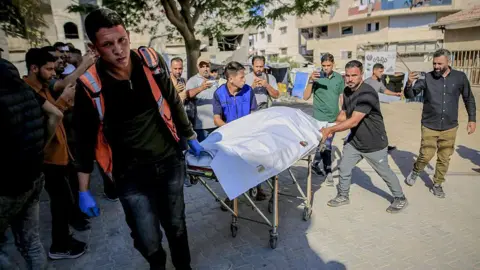
Iranian officials reported that 21 people, including four children, were killed in the attacks.
BBC Verify originally reported on the strikes on 28 March, indicating that a US Precision Strike Missile (PrSM) was likely responsible. US Central Command (Centcom), which oversees military operations in the Middle East, did not comment at that time.
Centcom later issued a statement on 31 March denying the involvement of a US missile, claiming that the footage was consistent with an Iranian Hoveyzeh cruise missile.
“US forces do not target civilians, unlike the Iranian regime which has attacked civilian locations in neighboring countries more than 300 times,” the statement added.
When pressed for details on experts' analysis, Centcom responded with “nothing to add” regarding their original assertion.
Lamerd came under attack on 28 February, with CCTV footage authenticated and geolocated by BBC Verify showing a munition moments before it exploded above a residential area. Experts previously identified what they believed to be a US missile due to its characteristics and proximity to potential launch sites.
In the initial report, analysts from defense intelligence company Janes and McKenzie Intelligence noted that the missile observed was likely a PrSM.
A New York Times report also supported the belief that a PrSM hit Lamerd.
US Navy Capt Tim Hawkins reiterated that Central Command confirmed the accusations were false, stating US forces did not attack the city or nearby locations during the first day of Operation Epic Fury.
“The munition depicted in the video appears to be twice as long, consistent with the dimensions and silhouette of an Iranian Hoveyzeh cruise missile,” he asserted.
Weapons experts countered that the missile's distinctive features were absent from the footage, casting doubt on Centcom's claims.
The same day, nearly 400 km east, strikes hit an Iranian school and military base in Minab, killing 168 people according to Iranian sources. Video analysis suggested a US Tomahawk missile was responsible.
US Defence Secretary Pete Hegseth announced that the incident was under investigation, emphasizing that US forces do not target civilian locations.
PrSM vs Hoveyzeh missile
Amael Kotlarski, a weapons analyst at Janes, indicated the Hoveyzeh missile's features are unmistakable in any view yet were not discernible in the Lamerd footage.
Another expert from McKenzie Intelligence noted that the missile clearly lacked the wings or external engine associated with a Hoveyzeh but exhibited canard fins consistent with a PrSM.
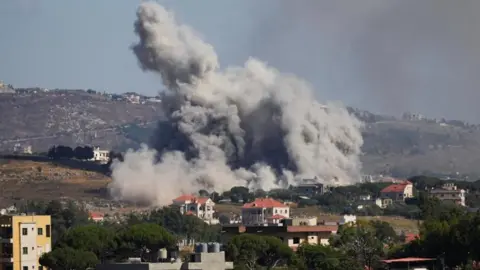
The verified CCTV footage reveals that the munition exploded mid-air over a residential area, a feature typically associated with a PrSM, designed to maximize damage by dispersing fragments over a wider area.
Images from the aftermath further suggested the use of an airburst munition, as buildings appeared riddled with small, tightly-packed impact marks.
“Those pock marks are witness marks of a fragmentation munition,” an analyst from McKenzie Intelligence explained.
Kotlarski elaborated that the technical sophistication displayed in the Lamerd strike confirmed capabilities not currently observed in Iranian missile technology.
Newly published footage confirms that there were three separate strikes on a sports hall, residential area, and near an educational center in Lamerd.
While the possibility of an Iranian missile malfunctioning is acknowledged, analysts consider it implausible for multiple devices to fail simultaneously above the same location.
Debris likely from the munition has been observed on the streets of the affected areas, though experts have yet to confidently identify such fragments.
While the initial target appears to have been an IRGC compound adjacent to the sports hall, no damage has been confirmed at this base, as both on-the-ground footage and high-resolution images have not indicated any impact.
While Centcom maintains its earlier statement denying engagement, the Israeli Defense Forces (IDF) stated they were unaware of any strikes in Lamerd on 28 February.
BBC Verify has sought additional details from Centcom regarding their assessment, but no further information has been forthcoming.