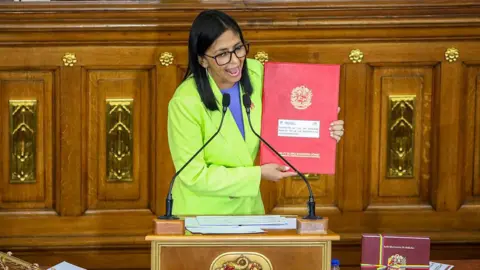
Venezuela's interim president Delcy Rodríguez has proposed new oil reforms in her first state of the union address since former president Nicolás Maduro was seized by the US.
Rodríguez said she wanted to reform the law that limits foreign involvement in the country's oil industry - a move away from Maduro's policies.
She said she was not afraid to face the US diplomatically through political dialogue, adding Venezuela had to defend its dignity and honour.
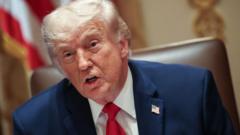
President Donald Trump has said US oil companies would move into Venezuela and make money that would go to people there and to the US, with a top official saying the US would control sales of sanctioned Venezuelan oil indefinitely.
Trump has asked oil companies to invest at least $100bn (£75bn) in Venezuela, but one executive said last week the country is currently uninvestable.
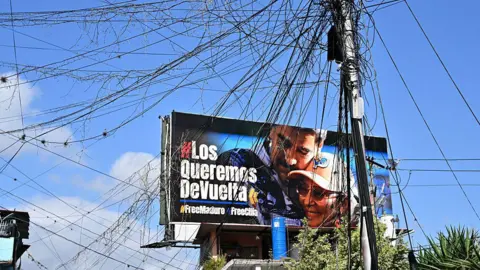
Rodríguez, the former vice-president, was sworn in on 5 January after US forces seized Maduro and his wife Cilia Flores in an operation in Caracas. They are now detained in New York, where they have pleaded not guilty to drug trafficking and other charges.
In her address, Rodríguez announced the proposal to reform the country's hydrocarbon law, saying she had asked the legislative body to approve it.
Until now, Venezuela's hydrocarbon law has stated foreign partners must work with the country's state-owned oil and gas company, PDVSA - which must hold a majority stake. The reforms, Rodríguez said, would allow investment to flow to new fields.
She said she had instructed her government to create two sovereign funds - one for social protection so that foreign currency goes directly to hospitals, schools, food, housing and the second for infrastructure and social development to invest in water, electricity and roads.
Venezuela has been facing an economic crisis, with a sharp rise in food prices and the lack of purchasing power. We're more worried about food. Venezuela is in bad shape. Inflation is eating us alive, one man said.
Rodríguez's reforms come as Trump and American investors eye opportunity in Venezuela, which holds the world's largest proven oil reserves.